𝗠𝗼𝗱𝘂𝗹𝗮𝗿 𝗔𝗿𝗰𝗵𝗶𝘁𝗲𝗰𝘁𝘂𝗿𝗲 𝗶𝗻 𝗢𝘂𝘁𝗦𝘆𝘀𝘁𝗲𝗺𝘀
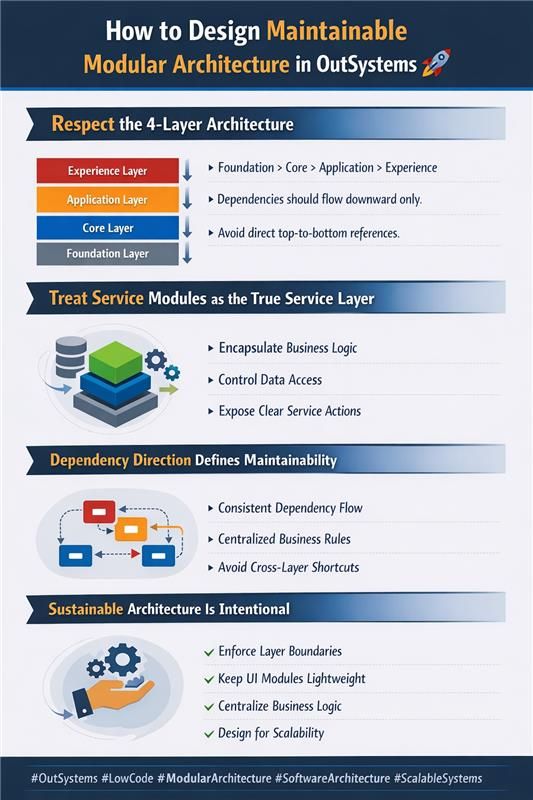
𝗛𝗼𝘄 𝘁𝗼 𝗗𝗲𝘀𝗶𝗴𝗻 𝗠𝗮𝗶𝗻𝘁𝗮𝗶𝗻𝗮𝗯𝗹𝗲 𝗠𝗼𝗱𝘂𝗹𝗮𝗿 𝗔𝗿𝗰𝗵𝗶𝘁𝗲𝗰𝘁𝘂𝗿𝗲 𝗶𝗻 𝗢𝘂𝘁𝗦𝘆𝘀𝘁𝗲𝗺𝘀 🚀
The real differentiator is whether your system can evolve without breaking every time requirements change.
As applications scale in OutSystems, modularization naturally increases.
More features mean more modules. More teams mean more layers.
🔎 Respect the 4-Layer Architecture
OutSystems promotes a layered architecture model:
• Foundation Layer
• Core Layer
• Application Layer
• Experience Layer
Dependencies should flow downward only.
When an Application module directly references the Foundation layer, or when a UI/Experience module depends on multiple Core modules in parallel, layering responsibilities may be becoming blurred.
Over time, this increases coupling, expands the impact of change, and complicates refactoring.
Clear dependency direction protects long-term maintainability.
🔎 Treat Service Modules as the True Service Layer
Within OutSystems architecture, Service Modules are not just a structural choice — they are the backbone of system design.
Key principles:
• Data and business logic should be encapsulated within Service Modules
• UI Modules should not directly manipulate underlying data structures
A well-designed Service Module should:
✔ Encapsulate business rules
✔ Control data access
✔ Expose clear, stable Service Actions as public contracts
This approach delivers two critical advantages.
First, the UI layer becomes lightweight and orchestration-focused, rather than logic-heavy.
Second, future UI transformations — whether moving from Traditional Web to Reactive Web, or from Web to Mobile — become significantly easier because business logic remains untouched.
Service Modules create separation.
Separation enables flexibility.
🔎 Dependency Direction Defines Maintainability
The number of modules is not the risk.
What impacts sustainability is whether:
• Responsibilities are clearly separated
• Dependency directions remain consistent
• Business rules stay centralized
• Cross-layer shortcuts are avoided
Improper dependency structures introduce hidden complexity — especially in large-scale enterprise environments.
🔎 Sustainable Architecture Is Intentional
Modular systems remain maintainable when:
✔ Layer boundaries are enforced
✔ Service Modules encapsulate business logic
✔ UI Modules stay lightweight
✔ Cross-layer access is deliberate and justified
Low-code accelerates delivery.
Layer discipline preserves scalability.
Further reading